The more things change, the more they remain the same. We have another Edmond legislator, Adam Pugh, touting a return to the practice of retaining elementary students who cannot read on grade level. We’ve tried this before, and it didn’t work. Parents rebelled, and school administrators asked for relief until the policy requiring 3rd graders to be held back if they weren’t reading on grade level was so watered down that it no longer made sense to keep it.
Oklahoma’s Reading Sufficiency Act began as a relatively straightforward early‑literacy framework: test reading skills early, identify students who are falling behind, and provide additional reading instruction to close gaps before they become permanent. The original 1997 law required reading assessments in 2nd and 3rd grade and required a prescribed program of reading instruction for students who were not performing satisfactorily. In 1998, the state expanded that early identification approach to include kindergarten and 1st grade.
By the mid‑2000s, RSA had evolved into a more formal compliance and documentation system. In practice, RSA shifted from a general mandate (“schools should intervene”) to an operational framework (“schools must screen, document, notify, and report on set schedules”).
RSA’s modern form—what most people recognize today—took shape in 2011 with Senate Bill 346. The main change was a third‑grade promotion/retention gate tied to reading proficiency and good‑cause exemptions.
Sen. Clark Jolley was a prominent legislative advocate for that shift. In 2011, Jolley’s public messaging framed SB 346 as an effort to prohibit “social promotion” so that students could demonstrate they could read at grade level before advancing. Senate press releases from that year quote him describing retention as a last resort—used when necessary to provide additional time and help to master foundational reading skills.
At the same time, State Superintendent Janet Barresi’s administration became a high‑profile champion of RSA’s accountability posture. That mattered because the policy’s controversy was never primarily about screening; it was about whether the state would actually follow through when students did not meet the third‑grade reading bar.
The howling began once districts faced the practical reality of retaining large numbers of third graders. In 2014, House Bill 2625 modified mandatory retention requirements and created a structured pathway for promotion in certain instances. A central feature was “probationary promotion,” based on recommendations from a Student Reading Proficiency Team (SRPT) composed of parents/guardians and educators. Governor Mary Fallin vetoed the bill , but was overruled by legislatures who had heard plenty from parents and schools. In 2017 the Proficiency Team Pathway was made a permanent option in the RSA law.
In 2024, Senate Bill 362 renamed and reorganized the RSA framework as the Strong Readers Act. SB 362 did away with retaining 3rd Graders behind in reading.
Senator Pugh believes a return to summer reading academies and 3rd-grade retention will lead to better outcomes for kids. However, he misses a larger point. The biggest obstacle Oklahoma faces in regard to improving reading is the teacher shortage and a lack of training in the science of reading. While a modicum of money has been allocated and earmarked for professional development in the science of reading it is far from what is needed. Oklahoma’s colleges of education are not turning out enough teachers to meet the demand in Oklahoma schools. Until real financial incentives are provided to attract more students into elementary education programs and for existing teachers to pursue Reading Specialist degrees it is unlikely we will see better results.
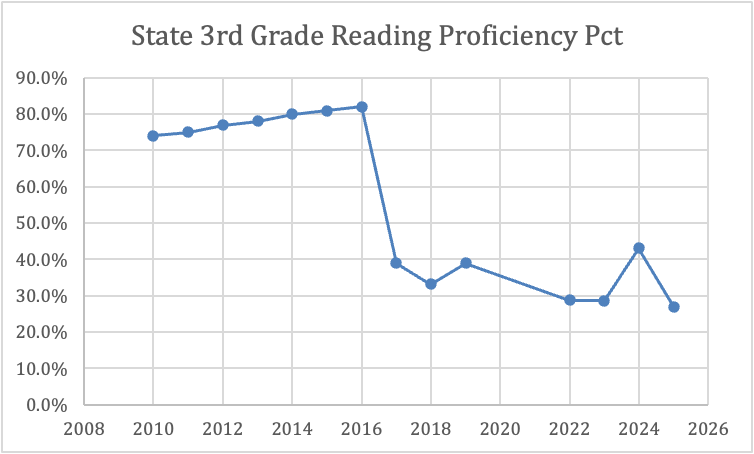
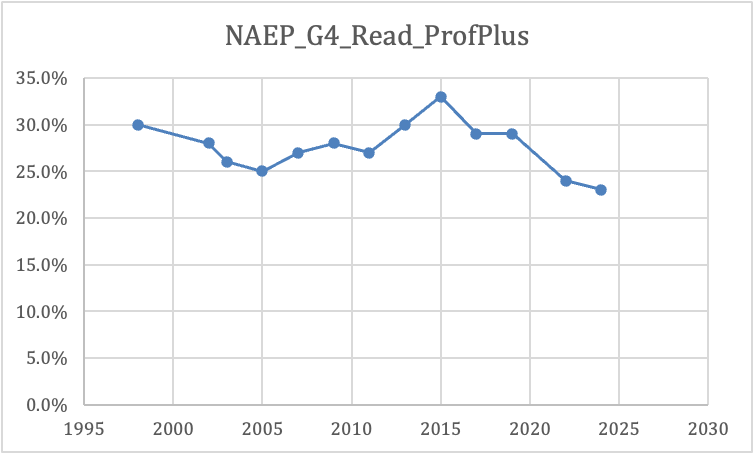
Below, I have provided data showing NAEP (National Assessment of Educational Progress) Grade 4 reading results since 1998 and OSTP (Oklahoma School Testing Program) Grade 3 reading proficiency from 2010 to the present. Taken together, these trends suggest that statewide reading proficiency has not improved in a sustained way despite repeated statutory revisions. I believe this is because RSA implementation has leaned heavily on compliance processes (screening schedules, documentation, notices, and reporting) without a matching investment in the instructional capacity needed to shift classroom practice statewide.
.
 Oklahoma Education and You
Leave a comment